mercoledì 11 maggio 2011

The Father of Democratic Color Photography


William Eggleston obviously didn't invent the color process, but he's considered the father of color photography because he gave to color the status of art, even if he not always recognized as an artist.
He started to use color photography i the early 60s, when it was still seen as vulgar, not enough élite being the media used by kodak to spread photography to always more consumers.
Not only Eggleston is a pioneer in this sense, but more because of the subjects of his art. He's innovative and democratic. His point of view is always new, he's not a tripod photographer, you can feel him moving, looking, searching. His home environment become the subject of his art, the beauty of everyday life and simplicity. The feeling of looking at something we always had in front of us and feeling peaceful for the first time.
I feel his work deeply influence from pop art, thinking about the high saturation of his colors and the subjects, but with a more nostalgic eye, more countryside than Warhol's circle, but fresh at the same time.
Also a strong evident influence is Cartier-Bresson's The Decisive Moment, from which he learns how to push the camera from different angles, breaking the rules, kicking it, getting down or laying on his back.
In here his democracy is rooted, where he's stopping by in front of a fast-food restaurant he's stopping by in front of a piece of human history. If art's aim is to transcend human experience to reach a world of pure beauty and peace, Eggleston manifestation of art is pure and strong. Art is hard, specially when you want to transform an everyday object in something ethereal. In this I see how strong is the affinity between Eggleston and Weston, behind their diversity they have a common aim.  Sometimes it's hard to appreciate, sometimes it can be wrong or hard to understand as all the subjective things are, but this is art.


http://www.amazon.com/Image-Makers-Takers-Second/dp/0500288925/ref=sr_1_1?ie=UTF8&s=books&qid=1305117709&sr=8-1

http://www.amazon.com/William-Egglestons-Guide-John-Szarkowski/dp/0870703781/ref=sr_1_1?ie=UTF8&qid=1305117675&sr=8-1

http://www.amazon.com/William-Eggleston-Postcard-Box/dp/1584180935/ref=sr_1_10?ie=UTF8&qid=1305117675&sr=8-10

http://www.amazon.com/Democratic-Forest-William-Eggleston/dp/0385266510/ref=sr_1_11?ie=UTF8&qid=1305117675&sr=8-11

http://www.amazon.com/William-Eggleston/dp/0500974969/ref=sr_1_14?ie=UTF8&qid=1305117675&sr=8-14

Deutsche Borse Photography Prize 2011

This prize has been set up in 1996 by The Photographer's Gallery in London and its aim was and is to promote the best contemporary photographers, making in this way the contemporary story of photography. 
This is a great way to get people who are interested in photography to know what's going on in the world and especially in Europe. 
The final winner is the one who left the most significant path in photography in Europe during the last year. 
The location was a warehouse space inside the University of Westminster, a huge place where the viewer had all the space to look at the images.
It was clear that the most interesting work, in general therms of photography, was Jim Goldberg's mix media reportage -indeed he won the prize-
The exhibited work -Open See- was astonishing: raw, emotional, true. All qualities that are hitting violently the observer; from the small polaroids to the big fragmented photo of desolation.
Even if I found Thomas Demand brilliant as usual, I felt that Jim Goldberg's work was the one to give a prize to.
The educational value of this work is high and the depth of his view is interesting as it is the use of different medias. Photo-reportage here uses the help of writings to be more clear than ever, more true and without two-ways. You can see people stories in their eyes and in their words.
Refugee tell their story and their thoughts and show their faces in a reportage that brings contemporary photography from the transcendency of contemporary art's status to the hardness of human experience.


http://www.photonet.org.uk/index.php?pid=4&show=20


http://londonist.com/2011/04/jim-goldberg-wins-deutsche-borse-photography-prize-2011.php


http://www.jimgoldberg.com/


http://www.magnumphotos.com/C.aspx?VP=XSpecific_MAG.PhotographerDetail_VPage&l1=0&pid=2K7O3R1493TK&nm=Jim%20Goldberg


http://www.photonet.org.uk/index.php?pid=4

mercoledì 4 maggio 2011

The Beauty of Forms

"Anything that excites me for any reason, I will photograph; not searching for unusual subject matter, but making the commonplace unusual."
In just two lines Edward Weston summarized all his extreme important work. 
Both if we are looking at his nudes or his architecture photos, the metaphysics essence of the work is what we can see. Even if we are still stick with the forms, in their phisicity, we can understand a spiritual power behind them, something transcendent. Something that just few great photographers succeeded in. A photograph of a shell becomes the door of another world where light and dark are playing a sensual battle. 
This could seem an hard work, but for Edward this become simply his modus operandi so he wasn't really interested in the criticism behind his work: All the things said about his work, more than something annoying, become something to laugh at or a point were to start to renew himself. 
This is what happened when he managed to meet Alfred Stieglitz in New York in 1922. Just after this brutal meeting Weston becomes to develop his personal touch. During this period he starts thinking that an artist needs to respond to the architecture of his time, trying to show that in a charming way. Here he becomes a precisionist where the functionality of the camera is transformed in a formal aesthetics.
Here everything born. He becomes free and new. Ready to become the Edward Weston everybody knows, or should.


Brett Abbott (2005), In Focus:Edward Weston:Photographs form J. Paul Getty Museum.

Edward Weston (2006), Edward Weston: The Forms of the Nude.

Edward Weston (2005) Edward Weston, Aperture Masters of Photography.


Terrence Pitts (2008), Edward Weston.

Edward Weston. (n.d.). BrainyQuote.com. Retrieved May 4, 2011, from BrainyQuote.com Web site: http://www.brainyquote.com/quotes/quotes/e/edwardwest141211.html 

domenica 1 maggio 2011

Martin Parr: between the funny and tragic

Martin Parr is one of that photographers that started already from where he wanted to go.
This because what he does is what he is: a critical viewer that can see from an outsider point of view. This ability is always use in his work, and that's mainly why his photos are so recognizable and famous. 
Parr is a documentary photographer who always kept a critical eye at the different aspects of modern life. SIce the '70 he studied painstakingly provincial mentality and lifestyle. When from b&w he moved to colour in 1984 his work gained more potential and peculiarity. The use of colour he does his typical of no many documentary photographers and it fits perfectly Parr's aim: this plastic and amateur touch produces glossy photographs that seem to be the natural expression on that reality on photographic paper. When you see them you think that's right, that's how it should be. Probably, in his work, the idea behind the photo is more appreciated that the actual photo, which out of the context could be a simple photo of a weekend out of town. The social and anthropological study behind them is the object the viewer have to focus on, not just the photo, which is just a media as a piece of paper or a found object could be.
In his photos paradoxical situations are shown, especially in the kitsch and provincial behavior of  the suburbs of England.
When the viewer looks at Martin Parr's photos he feels uncomfortable, unsure whether to cry or laugh in front of the sadness of our society costumes.


Martin Parr (1982). Bad Weather.
Martin Parr (1983). Bored Couples.
Martin Parr (1993). Home and Abroad.
Anne-Celine Jaeger (2010). Image Makers Image                    Takers, pp. 64-69.


venerdì 22 aprile 2011

Dance with Time


The work of Richard Avedon is definitely something that changed forever the history of fashion and commercial photography.
Before Avedon, leading magazines such as Vogue and Harper Bazar's were imposing an art deco style to fashion. 
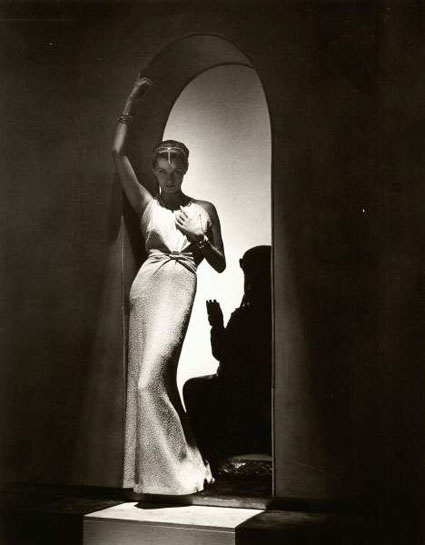
In the '20s, photographers such as Horst P. Horst are those who direct the market; despite the great fantasy and the visual power of their images, the models are frozen in a statuesque and classical pose. The research of beauty these artists are carrying out takes to an idealized woman who's just beautiful, sometimes sterile, as a statue could be, not an human being.


When Avedon, after the 2nd world war, arrives in Paris he changes everything. Really young he starts to work for Harper Bazar's, creating photos were the model are no more posing still, they are moving, jumping, living: the haute couture he's photographing seems to fit every occasion, from the theatre to the circus.


The emotivity of his photos is strong, it's true, and it is what the market is looking for: fresh air after the war.
After seeing all his photos what came in my mind is "time is passing": this seems to be the core of his work. If we have a look at his progress we can see it, passing from his jumping photos to his portrait period, to his western period, to the photos of his father dying.
I think death is something that scared a lot Avedon so he managed with the camera to freeze the time, to save his life.
Life is energy and that's what he gives with his photos. He started as a reportage photographer but than he realized that he wanted to create rather than be a viewer. He's never still. Passion and  power is what we can feel from his photos.
The other great changing he brought into fashion photography is the idea of a set to tell a story. 
When he starts to work for Vogue he becomes more interested in portraiture: the energy and surprise of movement is discovered in the face, something that he has always been - even unconsciously(this makes me think of his first assignment as photographer for The Merchant Marines)- interested in, and something that doesn't need a set to tell a story. More minimal but always effective.
Also thanks to Avedon we can now benefit of a wide idea of fashion which moves to art and vice versa.


Alberto Oliva, Norberto Angeletti (2007). In Vogue: The Illustrated History of the World's Most Famous Fashion Magazine.

Linda Watson (2007). Vogue Fashion: Over 100 years of Style by Decade and Designer, in association with Vogue.

Robin Derrick (2008). Vogue Covers: On Fashion's Front Page.

John Lahr (2008). Performance: Richard Avedon.

Laura Wilson (2010). Avedon at Work: In the American West.

Maria Morris Hambourg (2006). Richard Avedon Portraits.
Carol Squiers (2010). Avedon Fashion 1944-2000.


mercoledì 20 aprile 2011

The Art of Reportage

The sweet and strong touch of Leibovitz's finger is something hard to dislike.
The truth in her works is simply -wow- and beyond all the idealism and theoreticism of the critics, I believe Annie's photos hit the viewer directly in his deepest feelings.
If we consider her opera omnia we can feel the presence of Annie not just as a photographer, a detached and scientific eye, but we can feel she's living the moment.  She's part of the photo even if we can't see her, and this feeling is what keeps us focused on her work and make us feel part of that.
In her work we can see how influencing has been her college of art, in fact pictorialism is the essence of her whole work: the magnificence in the representation of her subject makes it iconic, no matter if the viewer knows it or not.


Her first period has been marked from the the huge character of Jann Wenner, co-founder and publisher of Rolling Stone. This part of her career is made of vitalism and presence. She's following on tour and the best musicians of the time and in her photos we can visualize her as part of the big party. She's friend with her subjects and her reportage becomes more intimate and special.
The turning point of her career is the photo that changed her life is when in 1980 she took the portrait of Lennon and Ono, with John nude and curled around Yoko fully dressed; few hours after this photo Lennon was shot dead. This incredible picture becomes more iconic than all other Annie's photos. The fetal position of Lennon seems to mark, unintentionally, the bitter nearness between life and death.
After this period Annie starts working also for the biggest fashion magazine in the US and in Europe and her style becomes even more pictorialist; the scene is no more free and true, it's a set that Leibovitz - with her stunning skills - gives life to.
Her punchy but gentle point of view is what made her one of the best photographers still alive, and this made her work more than reportage, it becomes art. 
She puts her soul in her work: as she told the Times "this is one life, and the personal pictures and the assignment work are all part of it". That's why we feel intimate her pictures, a rare beauty of our time.


Annie Leibovitz (2004). A Photographer's Life: 1990-2005.

Annie Leibovitz (1983). Annie Leibovitz: Photographs.
Gail Buckland (2009). Who Shot Rock and Roll: A Photographic History, 1955-Present.
Rachel Somerstein. (2008). Life Through A Lens. Available: http://www.pbs.org/wnet/americanmasters/episodes/annie-leibovitz/life-through-a-lens/16/

lunedì 21 marzo 2011

The Americans' Blues


Robert Frank's work is the best visual expression of the cultural movement known as the beat generation. He's beat generation's natural eye.


He moved from Zurich to USA in a florid moment for a persona like him. His pure spirit found the right place in the subculture of the time in America, and he embraced this visual, helped from his lack of education: an unfiltered view – you got eyes Kerouac said to him -
The climax of his work is The Americans, a book that I suggest everyone to look at. It's more than just a book of photos, it's a book of a country, of a time, it's a book that really picks the zeitgeist of the real America up; not the glossy one, not the always happy one, not the dream one: the Life. The Americans is the elegy of the post-war American's life in its essence, its purity, its harshness.
Frank's photography is spontaneous, it is vitalism and gloom.
Even if Kerouac wrote the introduction of the Americans, I think Frank's fellow spirit actually is Ginsberg. Energy, frankness and gloom are their sign.
Frank is all the larger that life Kerouac's vitalism, he's all Ginsberg's melancholy, he's all Ray Charles's energy; he's the voice of a generation sick and tired of fake smiles and lies, a generation hungry of truth, a romantic and auto-destructive society.
Look at his work listening to some blues and reading to some Ginsberg's poetry, that's the way to do it!

Hit the road Frank.


Reading:

Robert Frank (1959). The Americans. New York: grove Press

http://www.wussu.com/poems/agh.htm

http://www.amazon.com/Road-Jack-Kerouac/dp/0140042598