mercoledì 4 maggio 2011

The Beauty of Forms

"Anything that excites me for any reason, I will photograph; not searching for unusual subject matter, but making the commonplace unusual."
In just two lines Edward Weston summarized all his extreme important work. 
Both if we are looking at his nudes or his architecture photos, the metaphysics essence of the work is what we can see. Even if we are still stick with the forms, in their phisicity, we can understand a spiritual power behind them, something transcendent. Something that just few great photographers succeeded in. A photograph of a shell becomes the door of another world where light and dark are playing a sensual battle. 
This could seem an hard work, but for Edward this become simply his modus operandi so he wasn't really interested in the criticism behind his work: All the things said about his work, more than something annoying, become something to laugh at or a point were to start to renew himself. 
This is what happened when he managed to meet Alfred Stieglitz in New York in 1922. Just after this brutal meeting Weston becomes to develop his personal touch. During this period he starts thinking that an artist needs to respond to the architecture of his time, trying to show that in a charming way. Here he becomes a precisionist where the functionality of the camera is transformed in a formal aesthetics.
Here everything born. He becomes free and new. Ready to become the Edward Weston everybody knows, or should.


Brett Abbott (2005), In Focus:Edward Weston:Photographs form J. Paul Getty Museum.

Edward Weston (2006), Edward Weston: The Forms of the Nude.

Edward Weston (2005) Edward Weston, Aperture Masters of Photography.


Terrence Pitts (2008), Edward Weston.

Edward Weston. (n.d.). BrainyQuote.com. Retrieved May 4, 2011, from BrainyQuote.com Web site: http://www.brainyquote.com/quotes/quotes/e/edwardwest141211.html 

domenica 1 maggio 2011

Martin Parr: between the funny and tragic

Martin Parr is one of that photographers that started already from where he wanted to go.
This because what he does is what he is: a critical viewer that can see from an outsider point of view. This ability is always use in his work, and that's mainly why his photos are so recognizable and famous. 
Parr is a documentary photographer who always kept a critical eye at the different aspects of modern life. SIce the '70 he studied painstakingly provincial mentality and lifestyle. When from b&w he moved to colour in 1984 his work gained more potential and peculiarity. The use of colour he does his typical of no many documentary photographers and it fits perfectly Parr's aim: this plastic and amateur touch produces glossy photographs that seem to be the natural expression on that reality on photographic paper. When you see them you think that's right, that's how it should be. Probably, in his work, the idea behind the photo is more appreciated that the actual photo, which out of the context could be a simple photo of a weekend out of town. The social and anthropological study behind them is the object the viewer have to focus on, not just the photo, which is just a media as a piece of paper or a found object could be.
In his photos paradoxical situations are shown, especially in the kitsch and provincial behavior of  the suburbs of England.
When the viewer looks at Martin Parr's photos he feels uncomfortable, unsure whether to cry or laugh in front of the sadness of our society costumes.


Martin Parr (1982). Bad Weather.
Martin Parr (1983). Bored Couples.
Martin Parr (1993). Home and Abroad.
Anne-Celine Jaeger (2010). Image Makers Image                    Takers, pp. 64-69.


venerdì 22 aprile 2011

Dance with Time


The work of Richard Avedon is definitely something that changed forever the history of fashion and commercial photography.
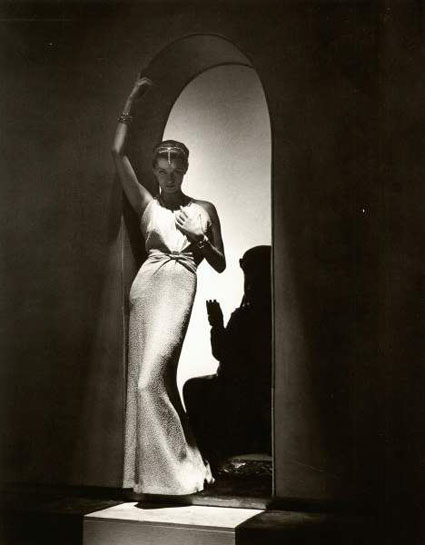
Before Avedon, leading magazines such as Vogue and Harper Bazar's were imposing an art deco style to fashion. 
In the '20s, photographers such as Horst P. Horst are those who direct the market; despite the great fantasy and the visual power of their images, the models are frozen in a statuesque and classical pose. The research of beauty these artists are carrying out takes to an idealized woman who's just beautiful, sometimes sterile, as a statue could be, not an human being.


When Avedon, after the 2nd world war, arrives in Paris he changes everything. Really young he starts to work for Harper Bazar's, creating photos were the model are no more posing still, they are moving, jumping, living: the haute couture he's photographing seems to fit every occasion, from the theatre to the circus.


The emotivity of his photos is strong, it's true, and it is what the market is looking for: fresh air after the war.
After seeing all his photos what came in my mind is "time is passing": this seems to be the core of his work. If we have a look at his progress we can see it, passing from his jumping photos to his portrait period, to his western period, to the photos of his father dying.
I think death is something that scared a lot Avedon so he managed with the camera to freeze the time, to save his life.
Life is energy and that's what he gives with his photos. He started as a reportage photographer but than he realized that he wanted to create rather than be a viewer. He's never still. Passion and  power is what we can feel from his photos.
The other great changing he brought into fashion photography is the idea of a set to tell a story. 
When he starts to work for Vogue he becomes more interested in portraiture: the energy and surprise of movement is discovered in the face, something that he has always been - even unconsciously(this makes me think of his first assignment as photographer for The Merchant Marines)- interested in, and something that doesn't need a set to tell a story. More minimal but always effective.
Also thanks to Avedon we can now benefit of a wide idea of fashion which moves to art and vice versa.


Alberto Oliva, Norberto Angeletti (2007). In Vogue: The Illustrated History of the World's Most Famous Fashion Magazine.

Linda Watson (2007). Vogue Fashion: Over 100 years of Style by Decade and Designer, in association with Vogue.

Robin Derrick (2008). Vogue Covers: On Fashion's Front Page.

John Lahr (2008). Performance: Richard Avedon.

Laura Wilson (2010). Avedon at Work: In the American West.

Maria Morris Hambourg (2006). Richard Avedon Portraits.
Carol Squiers (2010). Avedon Fashion 1944-2000.


mercoledì 20 aprile 2011

The Art of Reportage

The sweet and strong touch of Leibovitz's finger is something hard to dislike.
The truth in her works is simply -wow- and beyond all the idealism and theoreticism of the critics, I believe Annie's photos hit the viewer directly in his deepest feelings.
If we consider her opera omnia we can feel the presence of Annie not just as a photographer, a detached and scientific eye, but we can feel she's living the moment.  She's part of the photo even if we can't see her, and this feeling is what keeps us focused on her work and make us feel part of that.
In her work we can see how influencing has been her college of art, in fact pictorialism is the essence of her whole work: the magnificence in the representation of her subject makes it iconic, no matter if the viewer knows it or not.


Her first period has been marked from the the huge character of Jann Wenner, co-founder and publisher of Rolling Stone. This part of her career is made of vitalism and presence. She's following on tour and the best musicians of the time and in her photos we can visualize her as part of the big party. She's friend with her subjects and her reportage becomes more intimate and special.
The turning point of her career is the photo that changed her life is when in 1980 she took the portrait of Lennon and Ono, with John nude and curled around Yoko fully dressed; few hours after this photo Lennon was shot dead. This incredible picture becomes more iconic than all other Annie's photos. The fetal position of Lennon seems to mark, unintentionally, the bitter nearness between life and death.
After this period Annie starts working also for the biggest fashion magazine in the US and in Europe and her style becomes even more pictorialist; the scene is no more free and true, it's a set that Leibovitz - with her stunning skills - gives life to.
Her punchy but gentle point of view is what made her one of the best photographers still alive, and this made her work more than reportage, it becomes art. 
She puts her soul in her work: as she told the Times "this is one life, and the personal pictures and the assignment work are all part of it". That's why we feel intimate her pictures, a rare beauty of our time.


Annie Leibovitz (2004). A Photographer's Life: 1990-2005.

Annie Leibovitz (1983). Annie Leibovitz: Photographs.
Gail Buckland (2009). Who Shot Rock and Roll: A Photographic History, 1955-Present.
Rachel Somerstein. (2008). Life Through A Lens. Available: http://www.pbs.org/wnet/americanmasters/episodes/annie-leibovitz/life-through-a-lens/16/

lunedì 21 marzo 2011

The Americans' Blues


Robert Frank's work is the best visual expression of the cultural movement known as the beat generation. He's beat generation's natural eye.


He moved from Zurich to USA in a florid moment for a persona like him. His pure spirit found the right place in the subculture of the time in America, and he embraced this visual, helped from his lack of education: an unfiltered view – you got eyes Kerouac said to him -
The climax of his work is The Americans, a book that I suggest everyone to look at. It's more than just a book of photos, it's a book of a country, of a time, it's a book that really picks the zeitgeist of the real America up; not the glossy one, not the always happy one, not the dream one: the Life. The Americans is the elegy of the post-war American's life in its essence, its purity, its harshness.
Frank's photography is spontaneous, it is vitalism and gloom.
Even if Kerouac wrote the introduction of the Americans, I think Frank's fellow spirit actually is Ginsberg. Energy, frankness and gloom are their sign.
Frank is all the larger that life Kerouac's vitalism, he's all Ginsberg's melancholy, he's all Ray Charles's energy; he's the voice of a generation sick and tired of fake smiles and lies, a generation hungry of truth, a romantic and auto-destructive society.
Look at his work listening to some blues and reading to some Ginsberg's poetry, that's the way to do it!

Hit the road Frank.


Reading:

Robert Frank (1959). The Americans. New York: grove Press

http://www.wussu.com/poems/agh.htm

http://www.amazon.com/Road-Jack-Kerouac/dp/0140042598


venerdì 25 febbraio 2011

Who's This?


Who's him?

I see with eyes,
I feel with his soul,
I smile with his mouth,
but who am I?


I know the first thing to do when you enter a community is to introduce yourself, that's fine, but I feel this harder than I thought.
Sometimes I think I know who I am, but quite often I'm asking to my self which part of my character is just representation and which is the essence of myself. Am I what I do?
This could sound much je suis un autre, but that's just how i feel sometimes.
Maybe sometimes I think too much, but it's not always like that.

Despite this I'm a photographer - and I love it - I'm from Italy but I moved this year to London to get my degree in Photography with Contemporary Art.
London is great so I have a lot of sources of inspirations, and if I'll be good enough I'll catch the right train!

After this boring presentation, what you should expect to find here hope is not that boring! It'll be a melting pot of what I like, what I find around me, what I'm interested in, and myself.

At the end this a web-log, so maybe this will help me and you to find out who am I.

Hope we'll have fun!

Take it easy